Think & Discuss
Quick Check
Inquiry Task
Key points: 1. Cigarettes are accepted not because they are inherently "money," but because enough people have formed a shared belief and expect that others will also accept them—this is precisely a recursive expectation. 2. This belief does not depend on kinship, religion, language, or political loyalty, so it can circulate among people who do not know one another. 3. It replaces the demanding condition of "both parties' needs being exactly complementary" with the generalized trust of "we all accept the same medium," thereby expanding the radius of trade and eliminating the cost of re-negotiating each time. 4. The properties of cigarettes—being divisible, portable, and not prone to spoiling—lower the cost of use, but they are only supporting conditions and cannot by themselves explain monetary status. Answering only "because it is scarce" is an incomplete answer; the element of "collective belief" must be added.
Grading criteria (focus on whether the chain of reasoning is complete; a single conclusion is not required): A reasonable answer should point out that the stability of money depends on the stability of expectations. A sharp drop in supply makes people wonder, "Will I still be able to get them tomorrow?", while an influx of substitutes makes people wonder, "Does the one in my hand still count?" In both cases, willingness to accept will decline, and three possible trajectories may emerge—a return to barter, a shift to repricing in other widely accepted goods, or a marked contraction of trade. An opposing angle may also be raised: if the camp administration steps in to guarantee exchange, or substitutes for cigarettes are quickly recognized as the same standard, belief may be re-anchored, and the currency need not collapse. Therefore the key to judgment is not "fewer cigarettes, so it's definitely doomed," but rather the question: how many people still believe others will accept them? This is precisely where the boundary of "money is a system of mutual trust" lies.
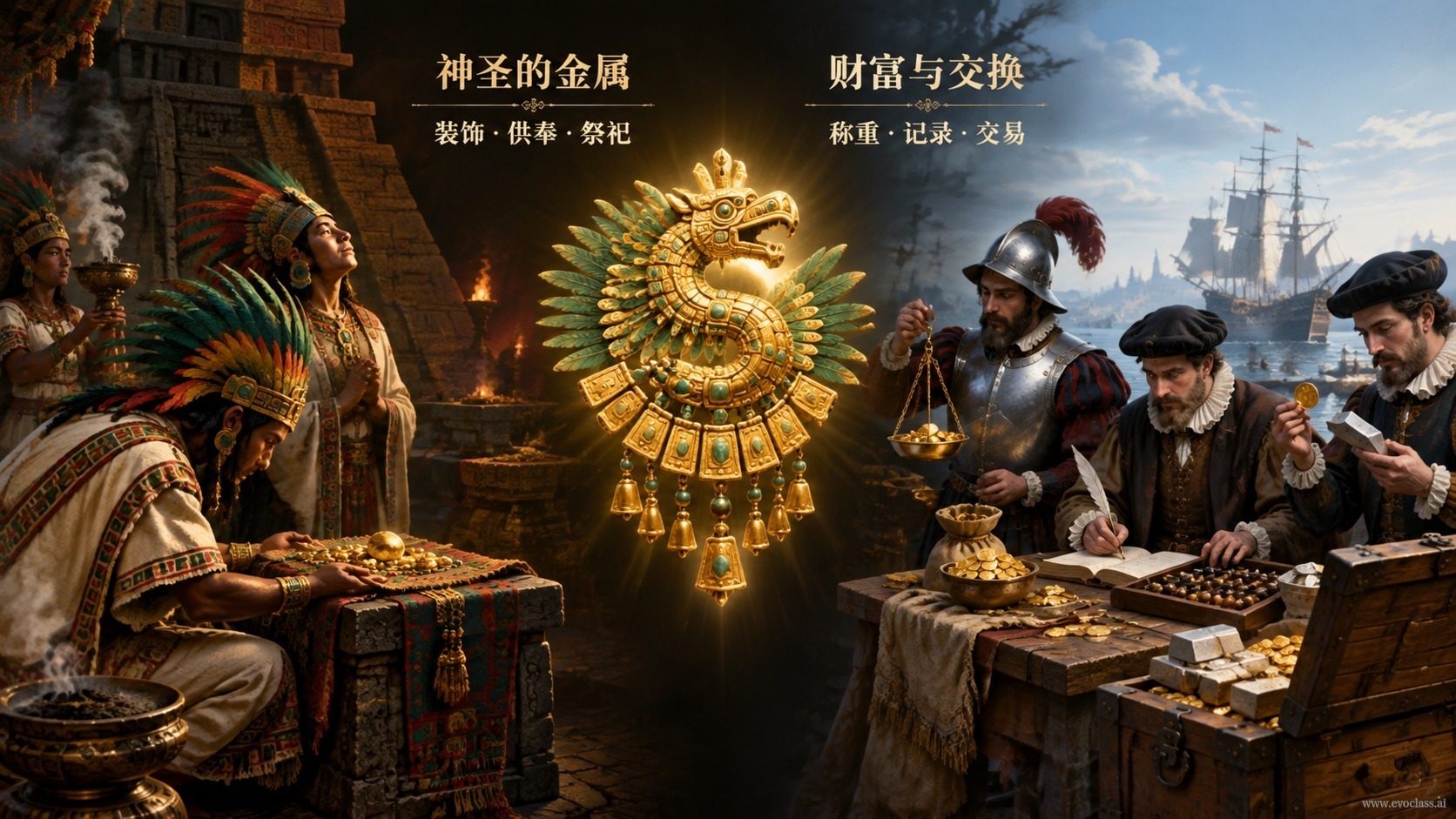
In 1519, Cortés and his party arrived at the Aztec Empire. Aztec artisans fashioned gold into jewelry, idols, and ritual objects, valuing its luster, malleability, and sacred symbolism; the Spanish melted gold into ingots, converting it into portable, exchangeable wealth. The same batch of metal carried completely different meanings within two imagined orders—this is the "puzzle of gold" that this page sets out to unravel.
The essence of the puzzle is that the two sides were not at odds over gold'sobjective valuebut rather belonged to two different imagined orders. Gold occupied a different position within each order, so its "value" was naturally different as well.
| Comparison Dimension | Aztecs | Spanish Conquistadors |
|---|---|---|
| What gold is | Decorative material and religious symbol | Store of wealth and medium of exchange |
| Where value resides | Aesthetic beauty and sacredness | A commensurable, abstract equivalent |
| Typical handling | Fashioned into jewelry, idols, and ritual objects | Melted into gold ingots for easy carrying and conversion |
The value of money does not reside in gold, shells, or numbers themselves, but comes from a fictional story that humans collectively believe in—it is the instantiation of "imagined reality" in the domain of currency. Money does not depend on kinship, religion, language, or political loyalty; it depends on only one thing:recursive expectationthat others will also accept it. Precisely because it demands the fewest objects of belief, it can cross religious and cultural divides—you need not believe in a particular god or monarch, only that the other party will also accept it.
Barter requires that both parties' needs be exactly complementary—"you need what I have, and I need what you have"—and this double coincidence keeps the radius of trade very small. Money transforms this coincidence into the generalized trust of "we all accept the same medium," thereby supporting large-scale cooperation among strangers, eliminating the cost of re-negotiating every transaction, and making mutual trust scalable.
Through trade contact, different societies gradually form shared beliefs about specific media such as gold; this convergence is driven by supply and demand and is also cemented by political power and long-standing convention.
Common Misconception: "It has value because it is scarce" only explains part of the selection. Scarcity cannot explain why shells, cigarettes, cattle, or even a string of numbers in a database can all serve as currency—the real explanatory power comes from "collective belief," not "physical properties." Gold became money not because of its atomic structure, but because enough people are willing to believe in it together.
But collective belief does not mean "say the word and it becomes money": it requires stable expectations, verifiable conventions, and the backing of power. Once trust collapses—through hyperinflation or the abolition of a currency—money can swiftly cease to function. This is precisely the boundary of the proposition that "money is a system of mutual trust." This page is the instantiation of "imagined reality" in the domain of currency; what follows will unfold the predicaments of barter in concrete situations, as well as the psychological mechanisms and morphological evolution of money.
Beginning with the Puzzle of GoldObserve the comparison chart in the image: the uses of gold in the eyes of the Aztecs and the Spanish (decoration/religion vs. wealth/exchange). Think about how it relates to "the Aztecs valued gold for its decorative and religious significance, while the Spanish saw it as a store of wealth and a medium of exchange."